

WHAT IS AT STAKE?
My central thesis is that if AI will indeed be able to undertake the cognitive tasks that we have previously assigned to purely human intelligence, bringing in a new age of automation across many sectors, human society must turn its attention to a very ancient idea: wisdom.
In the Tibetan Buddhist tradition, Manjushri is the Buddha of Wisdom, wielding the sword of clarity, personifying prajñā (wisdom)— not cleverness or accumulated knowledge, but the deep, liberating insight that sees through illusion to the way things actually are.
Our own minds and mental wellbeing are at stake. Digital technologies, especially social media, have created the ‘attention economy’ – focused on profit through tracking and maximising individual attention. We are witnessing the potential for AI to create the ‘attachment economy’ – focused on profit/market share through tracking and maximising emotional connection. To meet this challenge, we need to shift our focus from understanding ‘mind’ as an object of study (as in neuroscience and psychology) to understanding our OWN minds, subjectively.
Failure to do so could be as catastrophic as is playing out in the physical world through climate change, environmental degradation, and political conflict.
THREE CIVILISATIONAL LENSES
- Industrial civilisation
- Ecological civilisation
- Agentic civilisation
At this moment in history, as we contemplate a civilisational future based on the AI Revolution, we are told this will be as transformative as the Industrial Revolution, which birthed the industrial civilisation and the Fossil Fuel Age, with its focus on Progress as material prosperity and freedom for both the individual and commercial enterprise.
Under Xi Jinping, China is seizing this moment to declare that this transformation involving AI and Green Tech will be shaped by the lens of a new ecological civilisation. This vision insists that material prosperity must be balanced with spiritual fulfilment and ecological health, in a reciprocal relationship between humans and nature.
Another vision being pursued by AI enthusiasts like the European Nexus for Strategic Intelligence (ENSI) is an Agentic Civilisation. It envisions a world where “intelligence is abundant and agents do the work.” AI will not be a for-rent product owned by monopoly private enterprise, but part of the commons under democratic governance. In this vision the task is to build public National Agentic Technology Infrastructure (NATI): “so that agents can act usefully, safely and accountably at population scale. It is a stack — compute, models, data, memory, tools, identity, orchestration, governance — re-conceived around a worker that reasons and acts. But an agent is only as good as the identity it can verify, the registry it can trust, the tool it can call, and the human who can stop it.”
Both industrial civilisation and ENSI’s agentic civilisation are based on ‘capitalist realism’, put forward by British philosopher, Mark Fisher.
This is “the widespread sense that not only is capitalism the only viable political and economic system, but also that it is now impossible even to imagine a coherent alternative to it.”
Although modern China is often referred to as a form of ‘state capitalism’, China itself refers to it as ‘socialism with Chinese characteristics’—a blend of Marxist-Leninism, private sector markets and strategic visioning that draws on ancient Chinese thought, such as Taoism. Unlike the capitalist realism of industrial civilisation and agentic civilisation, China specifically identifies the need for an ecological civilisation that is not based on ‘abundance’, but on ‘bioregional sustainability’, which includes a human valuing of the natural world as one of relational reciprocity.
QUESTIONS
As we see in the rapidly emerging field of AI Companion Apps, a mix between a fiction novel and an immersive video game, a relational focus can have dire consequences for human emotional wellbeing in a world of capitalist realism.
This includes Apps such as Talkie developed by the Chinese company, MiniMax, whose tag line is “your dream chat partner awaits,” and where the algorithm is designed to continuously deepen emotional bonds, including sexualisation.
These issues underlie the new Duty of Digital Care legislation currently before the Australian parliament.
President Trump wants us to call AI (artificial intelligence) SI (super intelligence); signalling the ambition that the large language models (LLMs) of AI are evolving to a greater degree of self-organising agency (Agentic AI). While this raises the stakes for profit maximising and private monopolies, it also raises questions of state control and regulation on behalf of society in general. This is something all advanced economies that are deploying AI are grappling with, and which the ENSI vision of an Agentic Civilisation specifically addresses, but only within the framework of ‘capitalist realism.’
The Korean-German philosopher, Byung-Chul Han, suggests that while the new digital technologies promise greater freedom and connectedness, they are instead leading to self-absorption and burnout. In this way contemporary society has shifted from the disciplinary culture of external commands and prohibitions of the 1950s towards a performance-oriented culture driven by achievement, productivity and self-optimisation.
Drawing on his own cross-cultural background (Zen Buddhism and Taoism, combined with insights from the Frankfurt and French schools of philosophy and cultural theory), Han argues that we are seeing a new form of violence: over-achievement, over-production, over-communication, hyper-attention and hyper-activity. The result: a pathological landscape of depression, anxiety, attention-deficit hyper-activity disorder, and even borderline personality disorder.
He explores these insights in his Psychopolitics and in The Agony of Eros, the life affirming energy that is being subverted into consumerism. He declares we have thus created a society that is increasingly dominated by narcissism and self-reference and unable to form relationship outside the self.
China’s vision of a transition to an ecological civilisation raises a further question. If the evolution of AI into Agentic AI/SI is capable of surpassing human intelligence capabilities, where does wisdom fit into this ecological vision?
What is the relationship between intelligence and wisdom and how does this relate to questions of consciousness and what Australia’s Indigenous people call First Knowledges Law: The Way of the Ancestors?
This question throws a spotlight on what I have been calling ‘spiritual wealth’ as opposed to the ‘material and social wealth’ of industrial civilisation— wealth in terms of consumer goods, individual freedom, democratic governance, and medical services to protect human health.
Spiritual wealth is of a different order. It is the terrain of the inner psyche, of the realm of intuitive knowing that defies conceptual categorisation; of a sense of deep experiential connection to the whole of phenomenological reality in which we are entangled. A realm that industrial civilisation has colonised as individualised mental health, and AI is colonising through companion Apps.
However, as ancient wisdom of the esoteric traditions has always known, this domain, hidden from ordinary human conceptual intelligence, is so much more—allusive, illusive, elusive, yet knowable as the seat of wisdom.
WHAT IS HUMAN INTELLIGENCE?
Western culture, and the industrial civilisation it birthed, is built on the glorification of human ingenuity—the maximising analytical conceptual intelligence of the human species, as evidenced by our scientific discoveries and innovative technologies that harness these for the wealth and comfort of humanity. All of which has increased exponentially over the last 50 years across a range of fields including: information science, bio-engineering, medical science, finance, energy and transport, food production, manufacturing and the environmental sciences, etc.
Each has conferred both benefits and negative impacts on human society and the wider bio-regional world in which we are embedded and entangled. It is now calling all this to account in bio-regional feedback via climate change, ecological degradation and societal disruption across all polities.
The ENSI View of Human Intelligence
ENSI suggests intelligence is a multi-dimensional architecture, a living system of perception, abstraction, memory, adaptability, and strategy, which we can divide into two tiers:
1—Core Cognitive Capacities: The neurocognitive substrate—how fast, how much, and how richly your brain can process, store, and transform information in real time.
2—Emergent Strategic Capabilities: How that raw processing power is orchestrated into strategic, reusable, and self-aware structures of thought — capabilities that evolve not from biology alone, but from experience, feedback, and recursive abstraction.
Drawing on the lens of information science, ENSI then examines the nature of this intelligence through a range of metaphors that draw on the managerialism of ‘capitalist realism’—all derived from a world of meaning-making based on scientific materialism.
It is the ability of AI to perform these core cognitive tasks with greater speed and efficiency that has got the champions of ‘capitalist realism’ champing at the bit, anxious to reap the rewards of promised efficiency and productivity, which they have not been able to achieve through human intelligence alone.
Tier 1—Core Cognitive Capacities
- Mental Speed / Cognitive Reaction Time: The ignition spark of the cognitive engine. Just as the sharpness of a blade defines how quickly it can slice through resistance, mental speed determines how swiftly the brain can cut through stimuli, make sense of input, and initiate output.
- Working Memory: The mental juggling act in a gravity well. Imagine trying to juggle flaming torches while solving a riddle on a tightrope. That’s working memory — the rare faculty that allows us to hold thoughts aloft, reorder them, suppress distractions, and act — all without dropping the torch.
- Information Complexity Handling: The chess grandmaster of thought-space. This faculty is not about speed or memory — it’s about managing relational overload. Think of a strategist scanning a battlefield, seeing not just individual units, but how their movements impact one another. That’s information complexity handling — the art of cognitive binding.
- Abstraction & Relational Reasoning: The telescope of the mind — aimed at invisible constellations. Abstraction is the mind’s capacity to leave the ground and soar above the forest, recognizing the shape of the forest itself — not just the trees, but the laws that govern their growth.
- Visual-Spatial Processing & Pattern Recognition: The mental kaleidoscope — rotating reality until order emerges. Some see a mess of angles. Others see symmetry. Visual-spatial ability is the mind’s internal hologram, letting us rotate, zoom, warp, and decode spatial relations and visual patterns effortlessly.
- Cognitive Flexibility: The gearbox of the mind — shifting perspectives with elegance. Imagine a jazz musician switching keys mid-solo, or a martial artist flipping stance in mid-air. That’s cognitive flexibility — the mind’s agile capacity to change course, perspective, or strategy without stalling.
- Memory Span: The mind’s tightrope walker — balancing fragile thoughts across time. Imagine walking across a mental wire, carrying several thought-objects in both hands, with the wind of distractions all around. Memory span is that fragile, breathtaking act of holding pieces of information in their precise sequence — without dropping a single one.
- Mental Modelling & Systems Abstraction: The mind’s orrery — a dynamic model of reality rotating in thought-space. Some people see isolated facts. Others see an entire cosmos of cause, effect, flow, and feedback, turning silently behind every phenomenon. Mental modelling is the act of building that invisible mechanism in your head — and playing with it like a god.
What is interesting about the Tier 2 analysis below is that it is here that we see the claims and counter-claims for the evolution of AI into Agentic AI, or Super Intelligence. This includes the capacity to grapple with complexity and the insights of the ecological sciences about the actual interdependent and entangled nature of phenomenological reality. A reality that defies and subverts the boundaries of western knowledge systems, related governance structures, and operations of capitalist economies.
Tier 2—Emergent Strategic Capabilities
- Completeness of Understanding: The architect who not only builds the tower but knows every brick, beam, and blueprint. This is not mere knowledge; it is epistemological omnivision — a mental state where nothing critical is missing, and all parts are accounted for in relation to the whole. It’s not about having many facts, but about knowing the system in its totality.
- Conceptual Interconnectedness: The neural web-weaver — spinning bridges between islands of thought. This is the domain of high-order synthesis — the power to forge links between seemingly unrelated ideas, models, or disciplines. It is the wiring of insight, the birth chamber of creativity, metaphor, and elegant solution architecture.
- Strategic Entry Point Selection: The safecracker’s ear — knowing which gear to turn first. In a tangled mass of complexity, this ability lets the mind pierce with precision. It is the art of problem-finding before problem-solving — sensing where to begin, where leverage hides, and how to unlock momentum.
- Minimalist Solution Design: The sculptor who frees the form from the stone by removing only the unnecessary. This is the cognitive gift of conceptual minimalism — the ability to locate the core mechanism of a problem and design a solution that is maximal in impact, minimal in entropy. It is the pursuit of cognitive elegance: nothing more than needed, nothing less than sufficient.
- Automatability Awareness: The mental machinist — building systems that build themselves. This is meta-efficiency: the ability not only to solve a problem, but to do so in a way that makes future instances self-solving. It’s not just thinking well — it’s thinking how to stop thinking about the same thing again.
- Transferability / Generalization: The philosopher-engineer — turning insight into blueprint. This is the cognitive alchemist’s trick — transmuting a single solution into a pattern, framework, or algorithm that can survive across domains. It is the very opposite of overfitting: the creation of idea-objects that travel.
- Compression & Synthesis: The intellectual blacksmith — folding vast knowledge into a single, blade-like insight. This is conceptual compression — the ability to distil sprawling complexity into minimal, high-density representation. It’s the act of turning a library into a law, a thousand pages into a principle, a career’s worth of trial into a theorem.
- Failure Prediction & Resilience Engineering: The chess master seeing the trap before the board is even set. This is the pre-emptive mind — the capacity to simulate breakdowns before they occur, to design with fragility in mind, and to make choices that fail gracefully rather than catastrophically. It is strategy blended with thermodynamics.
- Temporal Strategy Layering: The 4D chess player — not just making a move, but laying traps three turns from now. This is the ability to think in temporal stacks — to sequence ideas, decisions, and insights such that each one lays the foundation for the next. It is strategy not as a flat line, but as an architectural timeline, where you build thinking about thinking into time itself.
- Self-Awareness of Limits & Unknowns: The explorer who maps not just the terrain, but the edge of the map. This is the metacognitive act of knowing the border of your own knowledge, and treating it not as a weakness, but as a strategic asset. It is the intellectual discipline of epistemic perimeter scanning — locating uncertainty, quantifying doubt, and directing cognition toward what is not yet known.
WHAT IS WISDOM?
My university education in sociology and history, and professional life in public policy prepared me well to work within this ENSI view of intelligence, and its application through managerialism in trying to manage complexity in public policy. I confess I was entranced by it, but two experiences in particular shattered this entrancement.
One was my direct exposure to a very different world—that of pre-modern Trobriand Island society in PNG. The other, as discussed in my memoir, Call of the Dakini, was an unexplainable experience I had when visiting the Trobriand Island collection of artefacts in the National Museum in Sydney. It was as if this radical shift in perceptual experience opened a hidden doorway in my mind. The very act of ‘knowing’ became much more mysterious. It sent me on a journey in what at the time I called the epistemological abyss. This took me through the intellectual landscape of cross-cultural mythology to eventually arrive at the door of Tibetan Buddhism.
What struck me when I first encountered the Tibetan Buddhist teachings way back in 1985 was their focus on wisdom as a domain of knowing, united with the development of compassion, as the basis of the spiritual life. And the way in which this tradition combined both rational analysis and the use of mytho-poetic modes of experiential knowing, revealed in the life stories of Buddhist masters, and methods of tantric meditation. I learnt how to experience deities as modes of knowing, not as conceptual ideas, but as inner experience, replete with ethical purpose.
This enabled me to escape the alienating prison of objectification that is the hallmark of modern civilisation, yet embrace both conceptual analytical reasoning and non-conceptual knowing.
An Inter-Faith Perspective
So much so, that I undertook a personal project to explore what other spiritual traditions regard as wisdom. To this end I interviewed people from the Christian and Judaic tradition, Aboriginal Elders and others from more alternative approaches. In general, wisdom in Western culture is generally reduced to practical knowledge gained through actual experience in life. However, when I probed further into what are the qualities my interviewees would look for in someone they regarded as wise, they generally identified these qualities: generosity, compassion for others, especially those experiencing some form of suffering or injustice, an ability to see all sides of the problem/issue, and to not show signs of prejudice, moral grandstanding, narrow mindedness or self-righteousness.
These qualities also inform the Inter-Faith non-sectarian approach taken by the Dalai Lama as a frequent spokesperson for Buddhism in general: “If within this life you remain a good, warm-hearted, unselfish person, you will be a good citizen of the world. Whether you are a Buddhist, a Christian or a communist is irrelevant; the important thing is that as long as you are a human being you should be a good human being. That is the teaching of Buddhism; that is the message carried by all the world’s religions.”
The Buddhist Perspective
Buddhism places overwhelming importance in understanding the nature of our own minds as the source of wisdom, rather than relying on external social structures or belief systems. As the Dalai Lama has explained: “Our mind is very cunning, very difficult to control, but if we make constant effort, work tirelessly with logical reasoning and careful analysis, we shall be able to control it and change it for the better.” This is undertaken by listening and hearing the teachings, reflecting on the meaning of the teachings, and putting the teachings into practice in daily life.
Finally, through the special methods of non-conceptual meditation, we are able to directly realise the nature of phenomenological reality as one of open potentially, indivisibly united with all appearances, including within our own inner being, our own nature of mind.
The ancient Buddhist master Chökyi Drakpa says: “Through the wisdom that comes from hearing, you are able to recognize the disturbing emotions. Then, through the wisdom that comes from reflection, you are able to overcome the disturbing emotions temporarily. And finally, through the wisdom that comes through meditation, you conquer completely the enemy of negative emotions and obtain the confidence of knowing inexpressible and inconceivable reality with the wisdom of discriminating awareness”. This level of wisdom is referred to as prajnaparamita: the wisdom that goes beyond.
Beyond Conceptual Mind
The Heart Sutra (The Sutra of the Heart of Transcendent Knowledge), which provides the foundational wisdom of the whole Buddhist path, explains the nature of reality as open potentially—the basis for developing clarity, compassion and inner peace in our own lives. Frequently mistranslated as ‘emptiness,’ this teaching is quoted in the aphorism: “Form is emptiness; emptiness also is form. Emptiness is no other than form; form is no other than emptiness. In the same way, feeling, perception, formation and consciousness are emptiness.” This sutra is not only the basis of Buddhist analytical philosophy; it is also the basis of methods that bring this into a realisation within personal experiential non-conceptual knowing, which in turn can be stabilised as a way of being in the world.
While it is possible to arrive at a conceptual understanding of the truth of ‘emptiness’ through analytical reasoning in Madhyamika philosophy, actual realisation is radically different. Such wisdom is the mark of a genuine Buddhist teacher and the basis of the esoteric aspect of many different spiritual traditions.
Sogyal Rinpoche (Tibetan Book of Living and Dying, 1992) explains the nature of such realisation through metaphor. “Imagine a sky, empty, spacious and pure from the beginning; its essence is like this. Imagine a sun, luminous, clear, unobstructed, and spontaneously present; its nature is like this. Imagine that sun shining out impartially on us and all things, penetrating in all directions; its energy, which is the manifestation of compassion is like this: nothing can obstruct it and it pervades everywhere.
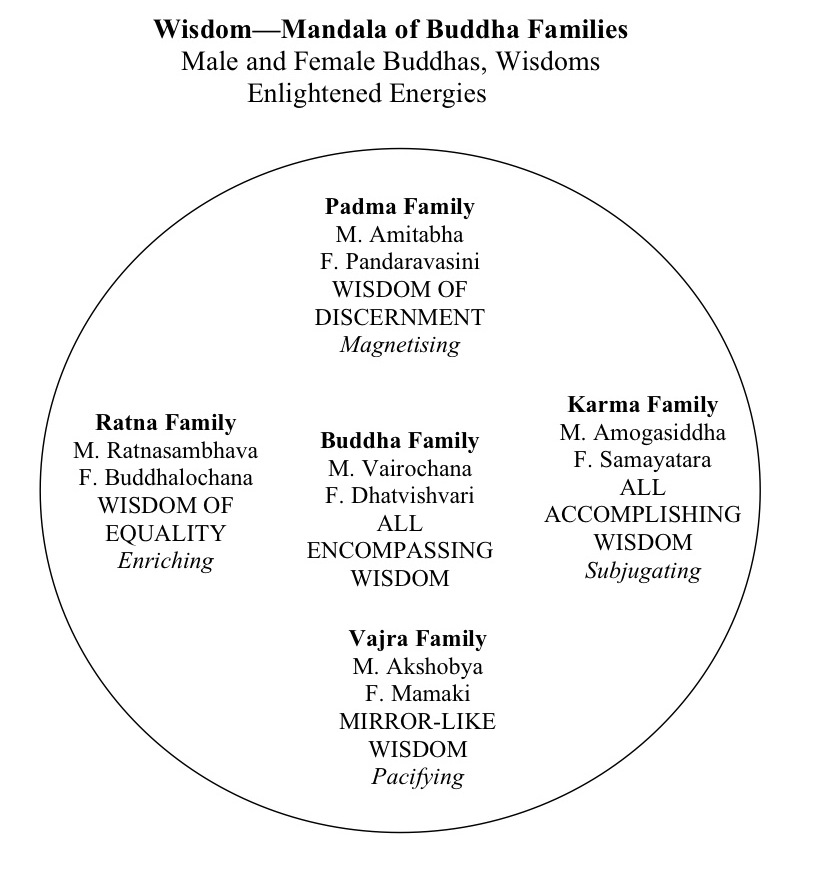
He uses the further metaphor of a mirror to describe its five different powers of wisdom—”the openness and vastness is the ‘wisdom of all-encompassing space, the womb of compassion; its capacity to reflect in precise details what comes before it is the ‘mirror-like wisdom’; its fundamental lack of bias towards any impression is the ‘equalising wisdom’; its ability to distinguish clearly, without confusing in any way the various phenomena that arise, is the ‘wisdom of discernment’; and its potential of having everything already accomplished, perfected, and spontaneously present is the ‘all-accomplishing wisdom’.”
These wisdoms are often expressed as the mandala of the Five Buddha Families—each with a masculine and feminine deity and associated type of wisdom energy as described by Sogyal Rinpoche.
Exploring Our Own Mind
We begin the Buddhist path of training in wisdom by training our ordinary conceptual mind to explore and understand the nature of our actual experience. The focus is on discovering how our strong sense of self and personal identity is not as solid as we think, but a moment-by-moment process of creating our sense of ego-identity from passing thoughts and emotions. Through such methods we discover the ‘non-self,’ and our intrinsic connectedness to the world around us. Both directly challenge the central role of the ‘individualised self’ in modern culture, which is the focus of most western forms of psychology and psychotherapy.
The Buddhist teacher Tsoknyi Rinpoche talks about the five types of ‘self’ that we can experience.
- Mere awareness and sense of personal agency, that sits behind our moving feast of thoughts and emotions that pass through the mind
- The grasping onto a solid sense of self, known as self-grasping
- Self-cherishing, the need to promote or defend the self or its opposite, self-loathing
- The social self, our dependence on validation by others
- The self that clings onto permanence, even beyond death
Being able to rest our mind in mere awareness, free of turbulent thoughts and emotions, is the Buddhist idea of mental health, which is characterised by clarity and compassion and a sense of inner freedom and equanimity. It is the basis of our sense of personal agency in the world. The other forms of self-identity are the causes of mental suffering. Yet they are the forms of self-identity that are promoted in contemporary culture currently being further intensified by AI applications.
CONCLUSION
The Buddhist approach to developing wisdom emphasises what is known as the Two Truths: that of the Relative (how things appear to our ordinary conceptual minds) and the Absolute (how things really are, once we have freed the mind of conceptual solidification). What blocks our inherent capacity for wisdom is mind’s tendency to freeze-frame (reify) the open potentiality of reality in union with all appearances, expressed in the metaphor like “turning water into ice.”
All proven spiritual traditions have emphasised the importance of wisdom in its manifestation as kindness and loving compassion, a sense of interbeing with the rest of our world, along with intelligent discernment—the ability see how things really are from all sides. The Buddhist tradition includes extensive teachings on how to actively work with our Relative minds to cultivate compassion through the Lojong teachings such as the Eight Verses of Thought Transformation, or the Seven Points of Mind Training.
From the viewpoint of the Absolute, the non-conceptual nature of wisdom as inner realisation, the teachings on this level of wisdom involve a very different pedagogy from that which has informed industrial civilisation’s highest forms of education—our university sector. Because of the dangers of ordinary conceptual distortion through the various traps of clinging to a false dichotomy of self and other, such teachings and insights are often regarded as esoteric, guarded from misuse by strong rules of secrecy and ethics.
The Spiritual Teacher
This domain of wisdom has frequently involved the rigorous training and testing of spiritual masters (whether known as Sages, Elders, Priests or Gurus) by their predecessors. Such training in many different spiritual traditions are designed to strip them of any tendency to ego-inflation, self-aggrandisement, and susceptibility to flattery or corruption (whether that be through sexual desire, financial greed, or bias).
All these traps are on display in the many media accounts of spiritual cults and misbehaviour by religious leaders in all traditions.
In choosing a spiritual teacher, in the Tibetan tradition students are advised to depend on the Four Reliances: on the message of the teacher, not on his/her personality; on the meaning, not just on the words; on the real meaning, not on the provisional one; on your wisdom mind, not on your ordinary judgmental mind. To understand the esoteric and fraught nature of this wisdom path in the Tibetan tradition, I recommend reading chapter 9, ‘The Spiritual Path’ in the Tibetan Book of Living and Dying, and The Guru Drinks Bourbon by Dzongsar Khyentse Rinpoche.
The Student
The journey to wisdom realisation also demands as much of the student in their relationship with their teacher, including their degree of self-awareness, honesty and discernment, along with humility that counters any sense of ambition and prideful achievement which is valorised in Western culture, along with the valorisation of fame in the spiritual teacher.
This expressed in the Christian tradition through Luke 18.25: “It is easier for a camel to go through the eye of a needle than for a rich man to enter the kingdom of God.”
If the AI revolution indeed challenges and replaces the primacy of human cognitive intelligence in society, and the focus shifts to wisdom for human development, then we are left with what this means for the future of pedagogy (learning) at all levels of our education system, especially at the tertiary, university level with its claim on higher-order knowledge and capabilities?
To meet the challenge of the AI revolution, we need to shift our focus from understanding ‘mind’ as an object of study (as in neuroscience and psychology) to understanding our OWN minds, subjectively. And for this we must turn to modes of learning that lie outside the totalising Western tradition that has shaped modernity and the international university sector.
Failure to do so could be as catastrophic as is playing out in the physical world through climate change, environmental degradation, and political conflict.


Recent Comments