
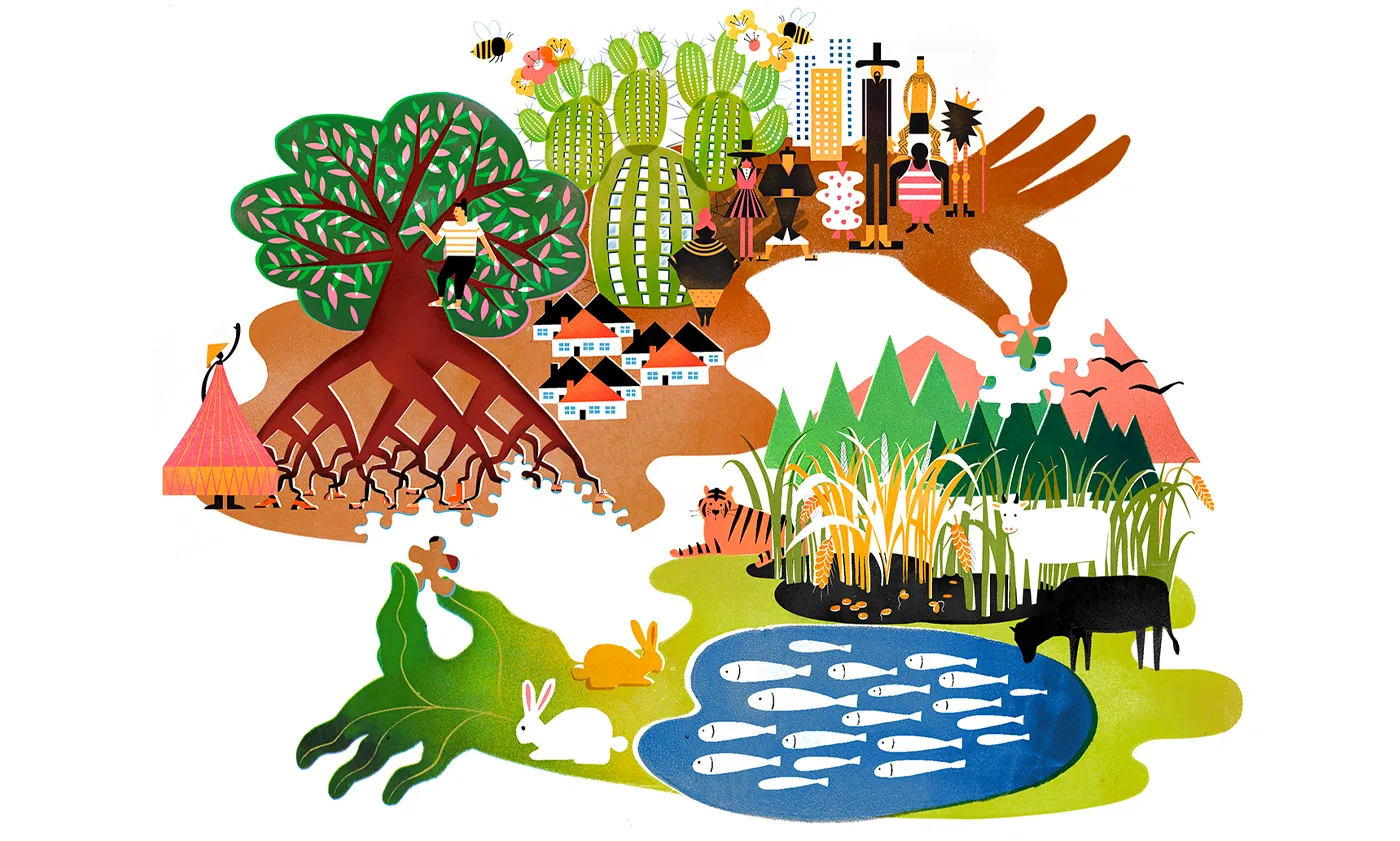
TOWARDS AN ECOLOGICAL CIVILISATION
—The Limits of Capitalist Realism
At the recent Lyrebird Festival, held each year in the Megalong Valley in the Blue Mountains, I listened to clean energy finance expert, Tim Buckley, in conversation with Mara Bun, talking about lessons for Australia from what is happening in China, via its Ecological Civilisation Strategy. First enacted in 2018, it is simultaneously a philosophy, vision, and compass for a green and prosperous future.
As anyone who was present at that conversation knows, I got very frustrated with Tim as, rather than address this wider vision, he focused on the investment opportunity for Australia in linking renewable energy to green steel production, in a new technological partnership with China, Australia’s major trading partner.
I wanted to go deeper into the paradigm shift behind the idea of ‘ecological civilisation’—a shift away from seeing everything through the lens of ‘capitalist realism’ and its focus on finance.
As the Asian Development Bank overview of China’s ecological civilisation strategy emphasises: many other historical transitions in the world have featured situations where people “conquered nature”, especially during the evolution of agricultural to industrial civilizations. Ecological civilization fits among the creative ideas of post-industrial and post-modern situations, and draws on China’s 5,000 years of ancient wisdom.”
While Mara explained that she and Tim were bankers; that investment is where dreams can be turned into action, via the clean tech revolution, I ask what is this dream in a fundamental shift to a new form of civilisation?
Tim is focused on the energy transition in order to address global warming through de-carbonisation of the world’s economy. In a talk at The Greenroom, Tim explained that while engineers ask “can we build it”, finance asks: “who pays, what is the risk and what makes it bankable?” Both he and Mara are deeply impressed by the sheer scale and speed of China’s leadership in the green energy transition and its global technological leadership in all aspects of green tech that is shaping the future of the world’s economy.
Tim, with his focus on ‘green steel’, argues Australia needs to be realistic about where much of the world’s clean-energy manufacturing capability now sits, and smart enough to work with it where that serves Australia’s interests. Unfortunately for the investment guys like Tim, so far old politics seems to be winning out over the reality of China’s global dominance, through its ecological civilisation strategy, in meeting the entwined challenges of climate change and technological innovation. Why?
THE POLITICAL LENS OF CAPITALIST REALISM
As the axis of global power shifts in favour of China, the Australian defence establishment seeks to prop up the old order of pax Americana. At the recent QUAD meeting, Australia’s Prime Minister has followed the AUKUS gamble to embed us more deeply with the US. Sadly, with Trump in power for another two years, the Democrats will struggle to overpower the ability of the East Coast Elites and Tech Bros to enact State Capture through big money.
To reduce dependence on Chinese supply chains in new and emerging technologies, Australia has signed the San Francisco Agreement along with Japan, India and the UK—all designed to counter potential Chinese expansionism. They seek to prop up the dominance of the US Tech Bros in what is seen politically as a competition between Western style democracy (reeling under the impact of increasing wealth inequality and inability to deal with climate change) and China’s authoritarian state-controlled version of capitalism (where government policy is not at the mercy of three-year election cycles and media-populism).
Western style democracy’s promise of government by the people for the people, to deliver prosperity and progress for all, has collapsed under a highly combustible pincer movement.
The rapacious uber wealthy elite state capture is meeting the rage of confusion and frustration of the majority of the population who recognise that this promise has been hollowed out by hypocrisy and the greed of vested interests, trying to hang on to their world of capitalist realism.
Capitalist realism and assumptions of Anglo-American dominance has a deep (and often unconscious) hold on our political leaders and media commentariat, as witnessed in the tired old insights offered by Jennifer Hewitt and Greg Sheridan on Sunday 15 November ABC Insiders’ Program. I cannot believe how banal Australia’s so-called top political journalists have become in the struggle for audience attention.
THE CIVILISATIONAL PARADIGM SHIFT
The lens of capitalist realism and great power political competition was on full display at both the recent QUAD meetings and the contrasting celebration of China’s technological might at the APEC summit in Shenzhen.
But this is distracting us from an even greater story.
China’s dominance of the green tech transition is anchored in a vision of the transition from industrial civilisation, through which the West achieved global dominance—economically, politically and culturally, to a new ecological civilisation.
To overcome its ‘100 years of humiliation’ that saw the collapse of the Manchu Dynasty at the hands of Western colonial powers, China set out to learn from the West. It has built its modern political structure on Western Marxist Leninism (with Chinese characteristics), and sought rapid industrialisation, with recent significant investment in technological innovation. However, in the face of the growing environmental crisis arising from global warming, pollution, and environmental degradation caused by this western-style industrial economic development, China’s new ecological civilisation strategy specifically rejects the instrumental rationality of Western materialism and the dualistic separation between humans and nature.
As well as the insights of modern scientific research, China has drawn on its ancient knowledge systems dating back 5,000 years, anchored in Confucian thought, Taoist philosophy and Buddhist ideals. China therefore takes the ‘long view’ in its strategic thinking. This is most famously articulated in the Sun Tzu’s Art of War, written in the fifth century BC. With its emphasis on awareness and flexibility for strategic effectiveness, it has been influential in modern business and military strategy.
To understand China’s vision of an ecological civilisation, Wang Yiwei suggests that we have to understand how its holistic approach differs from Western environmentalism’s dualistic, trade-off approach between economic growth and environmental protection.
In a similar vein to Indigenous ancient wisdom, this paradigm shift from an industrial civilisation to an ecological civilisation is based on relational reciprocity: that humans and the rest of the natural world are interdependent, not opposites nor separate. In this way it redefines the very basis of Progress, insisting that material prosperity must be balanced with spiritual fulfilment and ecological health. When considering the human-nature relationship, it embraces the Buddhist and Taoist ideas of mutual interdependence: harm to nature rebounds on harm to humans, while nurturing nature sustains human flourishing.
China’s vision for a paradigm shift from industrial civilisation to ecological civilisation was first articulated by Xi Jinping at the May 2018 National Conference on Eco-Environmental Protection—when China was facing a growing environmental catastrophe in the form of air pollution, soil erosion and pollution, desertification of the grasslands, and water scarcity. This laid the foundation for a national commitment to integrate ecological wellbeing into societal progress, through systemic governance embedded in the economic, political, cultural and social spheres across sectors and regions. This strategy now shapes China’s long term planning across all sectors. It does not preclude economic growth, but it insists that this sit within an ecological framework, with technological innovation a major driver in the transition.
—Challenges
In undertaking this transition from industrial to ecological civilisation, China faces the same challenges as does Australia: How can they exit from environmentally costly situations without destroying social cohesion? How can they build a national ecological civilisation employment strategy, with options appropriate for the various regions of the PRC? How can they ensure the adoption of environmentally-sound lifestyles and expanding citizen participation in defining and refining the pathways to the PRC’s greening? How can they address the need for synergies in solving complex problems such as pollution control and climate change mitigation?
Importantly, how will China avoid the Progress Trap that is enveloping so many developing countries seeking to emulate the West; where the interaction between resource availability, environmental degradation, and the pursuit of progress through human ingenuity and technology ends up causing problems that eventually damage or collapse society.
The Asian Development Bank reports that domestic actions for green development, green finance, green economy, circular economy, low-carbon economy, ecological redlining, ecological restoration and construction, green urbanization, climate change mitigation and adaptation, sustainable development, and the “War on Pollution” are prominent examples of shifts and investments toward ecological civilization already well underway. Sectors such as transportation, water, energy, mining, industry, tourism, parks and nature reserves, public health, and education, have created national, provincial, and local ecological civilization goals and plans.
—Limitations of Environmentalism
As we frequently see in Australia, environmental and cultural heritage protection is usually seen as a constraint on growth—whether this is mining, urban development, water harvesting for agriculture, deep sea fish harvesting, or gas extraction. Through the lens of capitalist realism, policy solutions turn to pricing: carbon taxes, emissions trading and investment incentives—tools that prioritise short term economic interests over systemic change, which is hard to sustain through short term political cycles.
By contrast, with its combination of state control and private sector market approaches, China is able to adopt a top-down strategy that seeks to use various measures to activate bottom-up public participation through ideas of collective responsibility at the societal and individual level, and to enforce systemic governance measures through cross-sector and long-term planning and implementation. China is a big country with a large population. There are many challenges yet to be overcome, but measurable progress is being achieved.
Wang Yiwei argues that Western environmentalism, via community activism or government reforms, primarily seeks to mitigate industrial civilisation’s harms, rather than redefining civilisation itself. It operates within the existing industrial-capitalist framework (of capitalist realism) rarely challenging its core logic.
This is because Western environmentalism, with its Triple Bottom Line corporate accounting, fails to understand the combined insights of ancient wisdom that preceded the extractivist logic of industrial civilisation, and not just the recent insights of the ecological sciences. In contrast to China, the philosophical underpinnings of Western industrial civilisation have remained anchored in the dualistic separation of mind/body and human/nature—going back to Greek philosophy and the scientific materialism that informed the shift from religious dogma to the rationalism of the Western Enlightenment.
Despite the insights of modern ecological science, the West has largely failed to understand the actual phenomenological nature of reality as one of intrinsic interdependent entanglement across all levels of manifestation: the mind-body complex, the human-nature complex, the time-space complex, the secular/spiritual dimension.
Our knowledge system is highly segmented between disciplines. Our governance system in turn is highly segmented between different government instrumentalities and levels of responsibility. With its focus on consumption, individualism and technological innovation as the engines of growth and prosperity, the industrial civilisation paradigm has systematically undermined the human need for inner spiritual sustenance, resulting in a tsunami of pervasive anxiety, depression and addictive substance abuse.
This basic ontological (understanding the nature of reality) and epistemological (knowledge system) failure informs the continuing collapse of Western economic, political and cultural dominance in the new emerging global order as we seek to grapple with the consequences of industrial civilisation.
—Different Perspectives
Just as China, faced with its ‘100 years of humiliation’ sent its scholars to the West to learn the secrets of its industrial might, the West must now send its scholars to learn from the ancient eco-spiritual Indigenous knowledge systems, and from modern technological China. And not just about the investment possibilities to shape Australia’s future economic foundations, which Tim Buckley is able to identify.
This learning must go much deeper, into a different way of thinking, feeling and knowing.
The French philosopher, François Jullien, who has studied Western ways of thinking through the lens of Taoist philosophy, says Chinese thought tends to propensity and strategy rather than moral positioning. It allows for the idea of situational potential, not abstract theorising. The focus is on ‘process’ and ‘living’ rather than ‘being’, with its correlative of ‘presence’ and ‘absence’, which has been the ground of European thought since the Greeks.
These ancient Chinese ways of thinking do not rely on abstract categories, which are then projected on to phenomenological experience. They regard the whole of reality as a regulated and continuous process that stems purely from the interaction of factors in play – at once opposed and complementary (the yin-yang). They allow for holistic intuitive modes of thought and experience, as well as deductive reasoning.
The Australian ecologist, Freya Mathews suggests that this ancient Chinese way of thinking offers new cognitive modalities outside the compromised parameters of the Western tradition, rooted in the ‘Theoria’ of Greek philosophy, which eventually via the Western Enlightenment, manifested as modernity.
This exploration in turn leads us back to the insights of Australia’s indigenous eco-spiritual ways of thinking, which are now being linked to ecological science and emerging technologies for bio-regional projects such as being advocated by Professor Ann Poelina in the Kimberley region of WA. Back in 2018, when Xi Jinping was announcing China’s Ecological Civilisation strategy to guide China’s great transition, Ann Poelina was calling for us to ‘wake up the snake’ (the creator spirit of rivers and waterways) to wake up the consciousness of the people to restore the ancient wisdom of our places. To restore obligations of stewardship and practices that increase awareness and consciousness that vital landscapes are animate, active, agential, inspirited and communicative. This call is now being enacted through ambitious projects to manage the future of the Kimberley in stark contrast to the extractivist policies of the current Northern Territory Government’s focus on gas and water extraction.


Recent Comments