
THE RESILIENCE INDEX
In their study of resilience in Australian communities, undertaken as a collaborative project by Zurich, Mandala and RedBridge and Accent Research, the most striking finding is that nearly half of Australians do not feel that they belong in their communities.
Belonging is key to the success of multiculturalism. It is also key to psycho-social wellbeing. The manosphere dilemma, as explored by Marc Fennell in The State of Man, speaks to this.
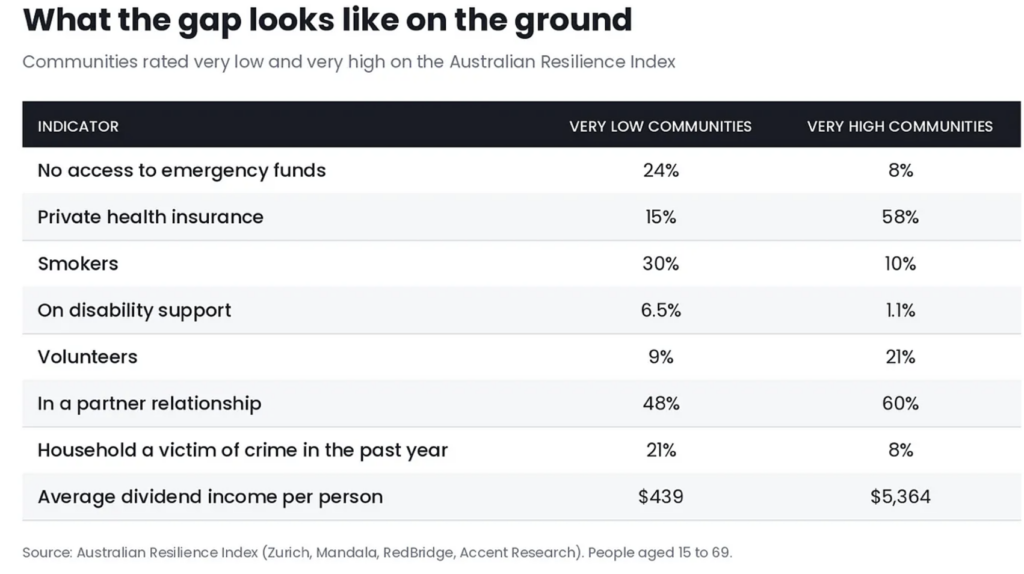
The Resilience Index tracks differences between metropolitan, inner regional and outer regional areas/electorates to reveal strong patterns of difference in resilience across financial resilience, health resilience and social resilience—each which fuel political discontent. Using a range of indicators that track financial, health and social resilience the Index maintains that this is what resilience difference looks like on the ground in Australian communities.
For the purposes of this blog, and in the context of the polarising political contest about immigration, and in the wake of the failed Voice to Parliament referendum, I am only looking into the question of belonging that sits within the social resilience index.
The authors state that the social pillar of resilience is where language barriers, crime, single parenthood and a thin layer of community organisations all show up. It is also where the question of belonging is measured.
WHAT UNDERPINS BELONGING?
What makes us feel we belong in our community? Social resilience is obviously one factor. The Index measures this through 9 indicators, including volunteering, community group activity, relationship status, crime victimisation.
They also measure it through whether people feel a weakened sense of belonging, and whether they feel like a stranger in their own country. And this is where things get tricky. In the least resilient communities, 54 per cent of people feel they don’t belong.
Yet, even in the most resilient communities, as measured by financial security, health status and social connections, there are still 37 per cent of us who feel we don’t belong in modern Australia.
About 36 per cent of Australians report a weakened sense of belonging, and about 31 per cent are uncomfortable expressing their politics in public. Those numbers are almost identical in rich and poor areas, in cities and in the bush. Estrangement has a gradient. Disconnection is everywhere.
Social resilience as measured in volunteering and social connections is strong in inner regional areas, despite registering poorer health and financial resilience.
However, it is in outer suburban areas where, despite strong health resilience, social resilience is often poor, and a sense of belonging is fragile.
This is where communities are new, with thin historical connections; families are depending on two incomes to finance housing; public transport is often poor; commutes are long and stressful and aspiration is high. It is where communities experience weak links to Australia’s institutional structures of support, especially in some migrant communities.
When cultural dissonance with mainstream Australia is stoked by the migration debate and the politics of frustration, it is easy to see why social resilience and belonging is weak.
We like to say we are the ‘Lucky Country’. That we are the world’s most successful multicultural nation. That we are a rich country. That we live in the best country in the world in terms of quality of life. Visitors find us relaxed, open and generous. And yet so many of us report that we feel like strangers in our own land. Mental health statistics point to a growing incidence of psychological stress and alienation.
While financial stress, the pace of technological change, and social media’s deliberate algorithmic design to promote rage, anxiety and division as highlighted in the film, ‘The Social Reckoning’ provide some explanation, it seems we need to probe further. In particular, why is our sense of belonging weak, even in high resilience communities?
THE ECONOMISM TRAP
Waleed Aly’s essay on the future of liberalism goes beyond blaming increasing wealth inequality via neo-liberal economics, much favoured by the political ‘left’. Instead, he has suggested that ‘economism’ (the focus on productivity as the measure of all things) and the scientific materialism that underpins Western liberalism (what Andreotti calls the modernity/coloniality complex) has progressively leached our world of shared transcendent meaning and purpose.
If this is the case, then the adoption of Universal Basic Income to solve the problem of the predicted impact of AI on employment will not meet this societal challenge. While creative artists might salivate at the prospect of a UBI, not everyone wants to be an artist. Instead, UBI will merely entrench wealth inequality between the small percentage of people still needed in an AI-run world (therefore being able to extract high incomes and associated asset accumulation) and the rest of us living on the UBI.
This immediately brings up a world envisioned in the 1982 film Blade Runner. With echoes in The Hunger Games. Modern society has trained us to find meaning and purpose through highly organised work structures, which structure our days independent of nature’s seasonal variations. This structure confers on us access to wealth, identity, friendship networks, and shared experiences. What might replace this in a future of mass unemployment being re-shaped by the search for AI-productivity, driven by the ideology of economism?
If it is ethno-religious nationalism, then in a multicultural society like Australia, we are in for a world of pain.
ENTANGLED REALITY
Post-colonial scholars, researching the recovery of Indigenous knowledge systems and the alternative framework they provide to the Western Enlightenment inheritance, suggest that this problem of belonging that assails us can be traced to the idea of human exceptionalism. Our sense of being separate, above, and over, the rest of the natural world denies the reality of our intrinsic entanglement with it.
Metabolically we know this through our bodies—our nervous system and bodily functioning, but cognitively we are trained via the Westernised knowledge system to deny it. Hence rising psycho-social suffering. Our connection to the natural world is ‘propertarian’—our ability to own it, make use of it, bend it to our will through cognitive control (science, technology, laws, regulation). We may love and treasure it. But it remains ‘other’. Unknowingly we grieve the alienation that flows from our human exceptionalism.
The most frequent criticism of Indigenous culture by the non-Indigenous population is that Indigenous people did not know how to make use of the land. That it took Western ingenuity and hard work to turn Australia into an agricultural and mining powerhouse. It is why many non-Indigenous Australians were reassured by Bruce Pascoe’s book, Dark Emu, that proposed a vision of Indigenous Aboriginal culture as agriculturalists in their own right. Anthropologist Marcia Langton credits the book for having shifted the perception that Indigenous people were “savage” before colonisation to “fully fledged human beings.” But this was criticised for implying the underlying idea that somehow nomadic hunting/gathering was inferior to agriculture, hotly disputed by some anthropologists such as Hugh Brody.
That this Western ingenuity took less than 250 years to destroy the land’s ecological resilience and fragile soils, dry up and pollute its waterways, denude its wild fish resources, and now generate potentially cataclysmic climate change is more difficult for the dominant ‘whitefella’ culture to acknowledge. Hence climate change and the need for an energy transition is ‘fake news’
The Western philosophical system, along with the Judeo-Christian religious tradition, privileges mind over matter. This influences how we experience the masculine and the feminine. Mind/rationality has been regarded as the natural prerogative of the ‘male’, while body/emotion/reproduction is the natural prerogative of the ‘female’. Women’s bodies are the seductive temptress of male reason. Their bodies are messy, polluted with menstrual blood, distorted and made ugly through the trials of childbirth and child rearing. In the words of Ann Summers, women can either be ‘Damned Whores or God’s Police’.
Western culture is logo-centric, deeply attached to the idea of the all-knowing, all-controlling patriarch—‘his’ commandments and the possibility of ‘his’ mercy/forgiveness. The nurturing feminine principle (matriarch) is largely neutered as the ‘virgin mother’, or survives as the ‘wise crone’, but yet celebrated in the idea of Mother Earth (Gaia) and feared in the figure of the Evil Witch.
Are the gender fluidity explorations, which are so widespread among our youth, a search for a pathway out of these persistent gender culture wars that feed the manosphere revolt against women’s socio-economic equality?
INDIGENOUS ALIENATION
While Indigenous Australians have maintained a strong sense of belonging to their Country, because many of them were forcibly separated from Country, language and kin through the processes of colonial settlement, it is not surprising that they also report feeling like strangers in their own land. This lies at the core of the intergenerational psychic wound that bedevils Indigenous Australians.
The Resilience Index reveals that in Halls Creek in Kimberly WA, 74 per cent of people feel like a stranger in their own country. In East Arnhem Land, Northern Territory, 77 per cent of people feel like a stranger in their own country. In Lingiari, 61 per cent of people feel like a stranger in their own country, the highest of any electorate. This reflects the reality that Indigenous people from these areas are the most incarcerated people in Australia—their lives defined by the criminal justice system as both victims and perpetrators, with high levels of suicide, substance abuse, unemployment and welfare dependence, and poor health.
The only civil war we Australians have fought was the colonial frontier wars between the colonising British and Indigenous Aboriginal and Torres Strait Islander peoples. It began with the arrival of the First Fleet at Sydney Cove in 1788, and has continued well past when Indigenous people were recognised as fellow citizens in 1967. During this time until the early 1970s, various state legislative controls (Aboriginal Protection Acts) exercised control over where Indigenous people were allowed to live, work and marry and have rights over their own children.
AIATSIS: The Acts gave a Board or agency (the Government Protector) comprehensive powers to regulate every aspect of Aboriginal people’s lives – from whether they lived on reserves, worked, had wages and entitlements withheld (now known as Stolen Wages), owned land, to their personal relationships and contact with family and community.
The NSW Aboriginal Protection Act was only finally abolished in 1969. Similar acts to control aspects of Indigenous people’s lives in Queensland, Western Australia, the Northern Territory and South Australia were not fully abolished until 1971. It is not surprising that many Indigenous people, who comprise but 4% of the total Australian population, feel like ‘strangers in their own country’.
I witnessed this personally when Tjilpi Bob Randall came to live at my house in Stanwell Park, a beachside suburb of Wollongong on the southern edge of the Royal National Park, to work on his book, ‘Songman” (2003). This part of Wollongong is almost exclusively a ‘whitefella’ area. When I was out and about with Bob people would look him with the question: “What are you doing here?” It reminded me of being the racialized outsider in PNG, but there I had the buffer of being a member of the colonial ruling class, even though married to an Indigenous man. It is instructive to become the stranger in another’s land.
Despite their strong cultural links to Country, as embodied in their Indigenous knowledge systems, glossed as ‘The Dreaming’ in the dominant culture of modern Australia, Indigenous people often find themselves cultural and racialised outsiders. In the metropolitan cities, they find themselves racially profiled as potential criminal offenders and subject to daily incidences of pervasive racial exclusion or abuse.
Already impacted by lack of financial resilience, their communities are also impacted by conflict around questions of identity, family lineage, and connection to Country as they seek to recover their culture and related knowledge systems from the wreckage of deliberative colonial destruction.
This includes the deep chasm between the values-base of their ancient cultural/knowledge systems and that of modern Australia, resting as it does on the foundations of its British institutional inheritance and the politics of neo-liberal orthodoxy.
As I often emphasise, when talking about ‘Closing the Gap’, we should consider this gap two-ways. Not just measuring Indigenous achievement against socio-economic indicators, but measuring non-Indigenous understanding of the principles and values of Indigenous knowledge system. They are well documented in such publications as the First Knowledges Series, published by National Museum Australia. ‘Law: Way of the Ancestors’ states that:
Given by the ancestors and cultivated over millennia, Indigenous law defines what it is to be human. Complex and evolving, law holds the keys to resilient, caring communities and a life in balance with nature.
One might respond: there is no greater challenge facing us today, than this.
THE MULTICULTURAL CHALLENGE
While the migration debate pretends to be about numbers and their impact on housing and infrastructure, most of us readily recognise its racialised undertones, most blatantly expressed in the Great Replacement Theory. This expresses the fear among particularly ‘white’ Christians that they will eventually be replaced by non-white Muslims. Raf Epstein reports that on his Melbourne ABC morning radio show he is increasingly receiving calls citing this fear.
I think we can read this as an expression of ‘Anglo’ (those who consider themselves of Anglo-Irish heritage) anxiety. The promise of constantly improved living standards for the ordinary ‘working family’ is meeting the reality of failed expectations. This is the dilemma of the Tradies with their investment properties who now see themselves as small business entrepreneurs; of Howard’s Aspirational Battlers in the outer suburbs hooked on getting ahead; of students with high HECs debt and collapsing career prospects in the new era of the AI revolution. Where calls to reduce government expenditure to fix inflation meets the harsh reality of diminishing government services and subsidies.
WHO IS TO BLAME?
Coming to grips with the end of an era of untrammelled wealth as measured in material goods and services and expanding opportunities for travel and leisure, is proving very difficult for many to make sense of.
It is complete madness and political suicide for any politician, be they Labor, Liberal, Greens or One Nation to promise that they can continue to raise our living standards, citing the fantasy of productivity or government nationalisation as the fix.
There is a refusal to recognise that this this era of constantly improving living standards rested on the unsustainable extractive exploitation of the Earth resources, and of the peoples of the so-called Third World under the umbrella of the ‘rules-based international order’, which is now in tatters under the combined assault of Trump’s USA, Putin’s Russia, Israel’s genocide against the Palestinians of Gaza and the West Bank, and the various insurgents across Africa and the Middle East who refuse to lie down.
China and India, seats of ancient civilisations, now stake their place in the sun.
If the old order of extractive exploitation by the nation states of the First World cannot be justified by the inherent superiority of the ‘white man’ and the superiority of human ingenuity via science and technology to master and control nature, then where can the blame be laid?
Is it the migrants once we abolished the White Australia Policy that privileged the ‘Anglos’? Is it Indigenous Australians who think they are entitled to reparation for the wounds of colonisation, who think they are special, yet who fill our jails as criminals? Is it women who have deprived men of their rightful place in society as the ‘boss/provider’ at home and in the workplace? The feminists who rage against toxic masculinity, driving men into the manosphere to regain their sense of worth.
THE EUROPEANS
The 1901 White Australia Policy was designed to protect Anglo-Irish Australians from racialised others, including non-English speaking Europeans, while Indigenous peoples were safely excluded by the various Protection Acts. After WWII, with the influx of non-English speaking Europeans, particularly Jews, Italians and Greeks displaced by the war, we ‘Anglos’ slowly learned to bring them into our cultural fold. Instead of despicable wogs who ate funny food, they became beloved sources of coffee culture and pastries.
After all we Europeans wore the same sort of clothes. Our cultural assumptions are shaped by both the Judeo-Christian religious traditions and/or the secular liberal humanism of the Western Enlightenment. We are all participants in the triumph of Western civilisation.
THE ASIANS (CHINESE AND SE ASIAN)
The strong migration from China and SE Asia that occurred after the Vietnam War and diplomatic recognition of the People’s Republic of China presented another wave of integration challenges.
However, they mostly dressed like us, largely kept to themselves in small businesses, and either adopted Christianity as their religion, or practised a form of Buddhism that was low key. Buddhism enjoyed a ‘good press’, attracting an interest in different forms of meditation among educated Anglos. Western Buddhism presented as a largely secular form of spirituality aligned with a growing interest in psychotherapy to deal with the ‘worried well’ (anxiety and depression) rather than those suffering from psychosis, the domain of psychiatry.
Anti-Asian sentiment was initially principally concentrated around the increasing use of recreational drugs, linked to Asian drug gangs. However, conversely, with the rise of a wealthy Chinese middle class in the burgeoning Chinese economy, Anglo culture found itself confronted with a whole generation of Asians who were coming to Australia as fee-paying international students. They often had considerable personal wealth at their disposal. Furthermore their children were outscoring the Anglos and beginning to dominate the professions. This was upsetting to the assumed natural order of dominance whereby Anglos occupied the top in hierarchies of wealth, business leadership and career prestige.
THE MUSLIMS
Migration from countries where Islam is the dominant religion has presented a much greater challenge for cultural integration. Such migrants have come from India, Pakistan, Afghanistan, Iraq, Iran, Palestine, Somali, Sudan, Syria, Turkey. Some from these countries are Christian, a minority are secularists, but the majority are Muslim.
Although Islam is also one of the Abrahamic religions that trace their origins to the Old Testament, it has retained values, beliefs and practices that challenge the accommodation that Christianity made with Western secular liberalism, including the role and rights of women in society, and the strong Christian claim that only theirs is the one true religion. As in the Jewish faith, in Islam men and women are segregated in their places of worship. Faith and the authority of Allah (God) have a much stronger hold, requiring daily prayer rituals not confined to the mosque. Many Muslim women also dress differently, wearing long skirts and hair covering such as hijab or even the full face covering such as the niqab and burqa. Many Muslims regard modern western styles of dress, including swimming costumes, as confrontingly immodest.
This cultural preference for a different way of dressing among many Muslim women has birthed a whole new fashion industry. It will be interesting to see whether aspects of it cross the cultural barrier across into the non-Muslim population.
I might add here that the Australian ‘Anglos’ who colonised Australia and PNG equally found their forms of dress confronting. In PNG, women did not cover their breasts. Men did not cover their buttocks, only their penises, and sometimes this with a gourd that poked up into the sky like an erect penis. Australian Aboriginal people used very minimal clothing on their bodies. Yet in both these cultures these modes of dress sat alongside quite elaborate cultural rules of modesty in permitted relationship behaviour.
I can remember my own surprise when one day, while I was in a seminar room at the University of Wollongong, waiting for the seminar to start some 15 minutes later, a young women dressed in jeans and a T-shirt, calmly set her bag down. Took out her veil and a long skirt, rolled out a small mat, and proceeded to do her prayers. Then afterwards rolled it all up, and resumed her seat as a jeans-clad teenager. I marvelled at the strength of her culture that enabled her to do this in a world, at that time, in which Muslim students at my university were quite rare.
It is not surprising that areas of weakest social resilience, which includes measures of belonging, are in areas of high settlement by both Muslim and Asian migrants such as in Fowler, Watson, Blaxland, and Werriwa in Greater Sydney. Their alienation makes them the target of persistent political and religious extremism as a vehicle for their simmering anger and frustration. Mainstream media continues to bait them as it chases clicks supercharged by algorithms designed to maximise both rage and the desire for the unattainable—whether that be wealth, fame, or a sense of secure belonging.
THE POLITICS
We see this play out in the desperate attempts of financialised content creators in the Influencer industry, the reduction of political analysis to entertaining memes on TikTok and Meta, the seductions of AI—easier, faster, better, personalised. The ease with which figures of authority can be ridiculed (Albanese) or lionised (Hanson).
This is the context in which the Victorian and NSW elections will play out over the next 6 months. In Trump’s reaction to the results of the US midterm elections which threaten the Republican majority in both the House and the Senate, and his flirtations with Putin. Whether the new Labor leader, Andy Burnham can lead the UK out of its Brexit wilderness. The rise of the Far Right in Germany and France.
Kos Samaras suggests that the Resilience Index gives Australia a way to see that in advance how policies will play out once we take a place-based approach. The Index tells us which communities can absorb the next shock and which will be changed by it. It tells us that the suburbs and the regions are fragile in different ways. And it tells us that the group with the least in reserve is women in the middle of their working lives.
He concludes that regional and outer suburban seat where the population is older, less diverse, in poorer health and a long way from services is the ground on which the contest for the disaffected vote is being fought. While they have a strong sense of social connection, they have lost faith in the idea that anyone in a capital city is coming to help them.
Canberra is the outlier to this world. It scores highly on all resilience indicators. It really is the Bubble.
It is what a community looks like when employment is secure, incomes are high and services are close. It is a useful benchmark. It is also a reminder of how far the people who make national policy live from the places the policy is for.


Recent Comments