

THE SOUNDS OF GRIEVANCE
The media world is awash with the sounds of grievance.
Anglo-Europeans fear they are losing their cultural, economic and political dominance in both world affairs and on their home ground through the forces of multicultural immigration. European imperialism, which grew the wealth of the Western world, fed return immigration flows from the Carribean, Africa, the Middle East and Asia.
US exceptionalism as the ‘land of the free’ has collapsed under Trumpist vulgarity, narcissism and greed. The blue-collar working class have finally realised that they are the ‘swamp’ that Trump would drain, rather than the East Coast elites of Washington, Boston and New York.
China and India are rising economic and political powers challenging Western hegemony and assumptions of intellectual and cultural superiority. The colonised Indigenous peoples of the world in Australia, the Pacific, the Arctic and the Americas are finding their voices and challenging the very foundations of the Western intellectual assumptions that underpinned the Age of Enlightenment and the liberal humanism of Western civilisation.
Victims of the European genocide against the Jews, the Jewish people of Israel have themselves become a genocidal power against their own Arab neighbours; once again finding themselves ethno-religious outliers in the world. Now seen as a pariah nation of extremists—even among fellow Jews who are recoiling in horror at the unfolding tragedy of Gaza, the West Bank and Lebanon, and as the war on Iran meets its own backlash. This is now playing out in the US, the major backer of Israel. One-third of Americans – including a similar share of Jews – say Israel has committed genocide against Palestinians, and more than half say they want the government to stop sending weapons to Israel, according to recent polls.
We are in the middle of blowback.
First has come the climate change crisis. The price of our expanding need for energy to fuel our economic goals and insatiable desire for material goods and lifestyle conveniences have breached the self-sustaining systems of our planetary home. Global warming is delivering increasingly catastrophic droughts, floods, hurricanes, collapsing glaciers and rising sea levels, and promises dramatic changes to our global food production systems.
The cost of living crisis sweeping the Western world is the harbour of a step-change in all the assumptions of modern economic management, which all the blathering about increasing productivity, via the AI revolution, cannot address. On Main Street, Round Rock in Texas, the epicentre of this week’s Blue Tsunami electoral tremors in the US, Billy Joe Wilson, 47, who was wearing a long beard, tattooed arms and a bright yellow T-shirt explained why he switched his vote to the Democrats. “I don’t want to live in a world where the rich eat the poor.”
Gen Z are finally rising up in answer to this plaintive cry as they confront unaffordable housing, be it rental or home ownership, rising unemployment, technological exploitation of their hopes and fears and the declining space to escape the surveillance powers of the State. Where a university education confers years of debt with no real expectation of economic reward except for the privileged few working in the financial sector. Where corruption is rewarded. Where those who profess leadership for all seem to only look after their own.
The implied social contract of democratic governance and liberal humanism no longer holds. While social media helps organise protests and builds global connectivity, young activists are also becoming more alert to the power of technology companies to shape what they see and how they understand the world.
While some Gen Z are pulled into the rage fire of Rightwing ethno-populism, others are directing their ire at the relentless logic of capitalism as the economic engine of modern societies. They conclude: “As a young person, it is not difficult to see that the future we’re facing is incredibly dire.” They are “furious with political elites, who shamelessly reap the spoils of opulent privilege while their countries suffer.” The Tech Bros have become the Anti-heroes of our times.
THE NATURE OF GRIEVANCE
Grievance carries two threads. One is grief. The other is resentment around ideas of fairness. Each eat away at our longing for the happiness that life in our modern world of cleverness and plenty is meant to deliver.
Grievance as Grief and Suffering
Modern medicine can hold physical death and serious illness at bay. Human ingenuity through science and technology has mastered the design codes of the natural world, bending them to our will to produce a vast range of consumer goods, available for delivery to our door at the click of a digital ‘button’.
And yet. . .
Despite a level of material wealth and convenience that our forebears could never have dreamt about, happiness and contentment seem to elude us. Anxiety and depression stalk us with ever more intensity.
Some 2,500 years ago in ancient Lumbini in a land we now call Nepal, a young prince, Siddhartha Gautami, born into the luxury of his day went in search of understanding why so many seemed to suffer, and to discover the secret of happiness. He did not turn to science and technology for his answers. Instead, he turned to the world of ancient India’s yogis and their mysterious practices of mastering human desire through various forms of asceticism.
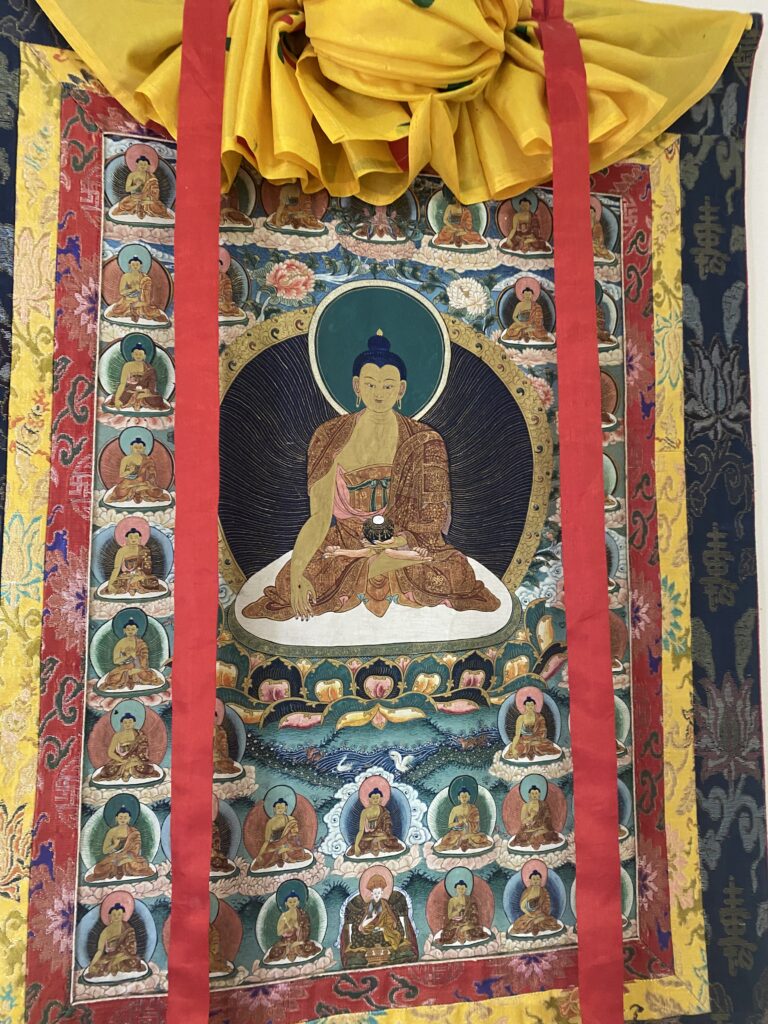
Finally, having found no satisfaction in their practices, he is said to have sat in meditation under a Bodi tree in a place we now call Bodhgaya, called the earth to witness and declared he would not arise from his meditation until he found the answer. In this way Prince Siddhartha became known as Buddha: the Awakened One.
This answer became the Four Noble Truths, the foundational teaching of Buddhism as a path to end suffering by deeply understanding the human mind and its afflictions in the face of the phenomenological reality of life on Earth. Life is impermanent and all phenomena arise through interdependence with one another. Change happens. We are not alone or separate.
Impermanence is a fact of all life—from the brief life of a butterfly to the geology of the Earth itself. We might feel that we end at our flesh as unique beings, but like all of life we exist within a vast web of relational interdependence, not only back through evolution, but moment by moment with each exchange of breath.
To fight against the tide of impermanence and try to make time and situations hold still is futile. Experiencing loss is part of experiencing life. Our sense of loss can be profound—the death of someone with whom we have shared intimate closeness, such as a parent, intimate partner, or long-term friend, and in the end (death) of a relationship we treasured. It can include loss of treasured possessions, of a job or career prospects, of our physical and mental health. Of somewhere secure to live, be that a home—a roof over our heads or even our ability to live safely in the country of our birth and sense of cultural identity.
To think we can protect ourselves, our families, or our communities against the reality of interdependence is equally futile. Like it or not, we live in a vast web of connections—ecologically, politically, socially and emotionally across both time and space. In ancient India this was visualised as Indira’s Net of Jewels.
In this insight, Siddhartha taught the pervasive Truth of Suffering that afflicts all human beings. Not just the physical suffering of pain from illness, injury and death, but the mental suffering in our anxiety about such possibilities and in the tension between our sense of individuality and aloneness, and our intrinsic entanglement with all of life around us. From these insights arose an understanding of the Truth of the Causes of Suffering.
Although modern medical science has shown us it is possible to ameliorate many aspects of physical suffering due to illness and injury, death still comes to all of us. Further, because of the interdependent nature of reality, many medical treatments have unintended consequences, and many illnesses have arisen as a result of our modern practices with agriculture, food processing and the pace and stress of modern life.
Other insights from science and their application into a variety of technologies has resulted not just in a rich array of consumer goods and convenience by way of physical transport and digital connection, but also in ever more destructive and terrifying weapons of war and malicious surveillance control over our lives, but also in the manipulation of our emotions to our detriment.
However, all is not lost. It is possible to put an end to suffering – the Truth of Cessation. Not an end to physical suffering and the turmoil of impermanence, but to our mental suffering through learning how to work with our own minds and our human vulnerability to three basic tendencies that trap us in mental suffering.
One, the most basic of all, is ignorance: our failure to recognise the phenomenological nature of reality as it is, and our attempt to project onto it, what it is not. We do this through various concepts and ideas tied up in political ideologies, religious beliefs and cultural assumptions that all give birth to various forms of prejudice in our search for certainty. The other two are desire (wanting) and aversion (not wanting). We can experience desire as relentless wanting, yearning, greed, and even sexual lust, descending into the grip of various forms of addiction.
Almost unique among all animal species, human sexuality is not limited to hormonal triggers associated with reproduction. Thus, as anthropological studies attest, all cultures have developed various rules around human sexuality and its expression in gender, age and kinship relationships. Often anchored in religious beliefs, self-worth, questions of reproductive rights, property ownership and inheritance, these rules are often a source of deep and enduring mental and social conflict.
Finally, to enable us to experience the Cessation of Suffering, Siddhartha gave the teaching on the Eightfold Path to end suffering: right view (understanding) motivation (intention), action, livelihood, effort (diligence), mindfulness and concentration (awareness). There are many ways this teaching is expressed in different Buddhist cultures.
Grievance as Complaint
Our sense of complaint arises from unfair treatment of ourselves or others that we care about, which gives rise to resentment. This can also come from unmet expectations—be that from the behaviour of others we are invested in, or in a wider set of expectations about how our lives were meant to unfold.
This sort of grief as grievance is now being felt on many fronts. The feeling that the promise of increasing prosperity through technological progress and economic growth is now broken for the most, but monopolised by the few. The promise that democratic governance would deliver a fairer society that serves the people, rather than the privileged few as in old aristocratic times. The growing realisation that the good times enjoyed by the post WWII Baby Boomers is over.
Fairness has particular traction in Australian culture. We have been brought up on the idea of the ‘fair go’ for everyone, and an equally strong aversion to the odour of bullshit, whether that be in the guise of hypocrisy or grandiosity. Increasingly we feel assaulted by both. The ‘tall poppy’ syndrome is alive and well and acts as a counter to the modern obsession with ‘fame’ as currency. When you look at the people Australia has chosen to honour in the national Australia Day Awards, they are overwhelmingly for people whose activities have been for the benefit of ‘deserving’ others.
We have long demanded authenticity in our heroes and shown derision for those who failed this ‘pub’ test. Sadly, authenticity is now at the mercy of the ‘fake’.
THE POLITICS OF GRIEVANCE
Thus, the political landscape is alive with the politics of grievance, both real and imagined, as we all come to terms with the end of an era in human history, where we lived under the illusion that we could have it all. That the world was our oyster, endlessly able to deliver wealth and prosperity through the magic of science and technology, and endlessly able to absorb the costs, the collateral damage that economists dismiss so carelessly as externalities. The plastic waste that pollutes our waterways and soils. The chemicals that poison the air, the soil, the waterways and along the food chain of the food that we consume.
The environmental scientists keep telling us we are in overshoot. We have breached the sustainability limits of the biosphere. That we are bequeathing to our children and their children a world of increasingly unbearable heat and all its consequences. Perhaps it is why this year’s Booker Prize in literature went to Johnson’s “The End of Everything”. In an interview he says: “It is a book designed to present the explanatory collapse and epistemological collapse that you see in societies that have suddenly lost their grounding.” When he conceived the idea of the invading alien species as the iGhettis, which appear as “tall writhing bursts of light”, he realised that this is a play on “I get it” (explanation), “I get stuff” (capitalism), Getty (extreme wealth), Apple (tech), I (Freud)”—the demonic forces of our modern times.
Julianne Schultz suggests that the cynicism towards politicians today is that few public figures seem to have mastered the ability to actually hear what is being said, distil it, turn it around and provide a path forward. They keep trying to sell the dream. We keep trying to believe in it. Looking for someone/something to blame. We want to turn the clock back or as some politicians say, ‘get back on track’, or ‘get our country back’ or ‘make (x) great again’. Our political class refuse to make us face reality. Selling us the dream is what gets them re-elected. Managerialism is how they try to cope.
Managerialism
Instead, our political leaders have become victim to the managerialism of business and bureaucracy that has infected the professional classes via the proliferation of MBA graduates and the consultancy industry they proliferated. It’s increasingly difficult to tell them apart
As Schultz says, we are stuck on listening to vacuous talking points, carefully manufactured lines that show little insight into the real pain, anxiety, social depression and hopelessness, which many are feeling. This is precisely because ‘they’—the upper echelons of government administration, business leadership, media commentariat and the university sector are largely protected from the pain. They are still largely swimming in the dream. It is why people are so frustrated with the Albanese Government, and find themselves spinning off into the anger trenches of One Nation and the manosphere.
With the exception of Gina Rinehart and her ilk, Australia’s managerial elite may not be the uber rich of Trump’s America, but they are more than comfortable on their six-figure incomes and bonuses.
Authenticity
Like Trump with his particular combination of garbled sentences, charismatic charm, and menacing vulgarity that puts a finger to social propriety, Australian politicians like Barnaby Joyce have long exploited the ‘authenticity’ factor. The garbled sentences with the liberal use of Australian slang, the Akubra hatted folksy persona and ‘bad behaviour’. Not as gross as Trump with his UFC showcase, but who can forget Barnaby drunk in a Canberra gutter, fresh on the heels of his affair with his Chief of Staff—now communications consultant for One Nation.
In a similar vein, Pauline Hanson has harnessed the desire for authenticity because she speaks like ordinary people, not the professional managerial class. She has also harnessed the grievance factor as the victimised and despised underdog because she lacks their professional polish. Her patronage from uber-wealthy Gina Rinehart, complete with a gifted private plane and sartorial splendour, perhaps seen as a ‘finger’ to the pretensions of the managerialist ‘Toffs’ of Canberra and Big Business.
The Democracy Index shows that trust is plummeting and cynicism increasing. Just as the Resilience Index has shown that nearly half the population do not feel they belong, the Democracy Index shows that the same proportion think that politicians don’t understand ‘people like me’.
In the US, the MAGA (Make American Great Again) movement was birthed in frustration with the Democrats who were seen to be captured by the vested interests of the elite East Coast professional classes. The GFC was the turning point when the banks who caused the whole sub-prime mortgage debacle that tanked the global economy were bailed out by taxpayers because they were ‘too big to fail’ without crashing the entire economy. Investment bankers were very soon back at it, reaping huge bonuses on stock market trading—the business version of casino gambling. As they say, it’s been a bull market as the investor class track their growing wealth, while the workers of the world try to get a second job to meet the rent.
Trump came along in the US, the cultural flagship of the Western Civilisation, as the hero figure who promised to ‘drain the swamp’ of the elite managerialist class. His approach was particularly shaped by US culture, which has long glorified extreme wealth and fame, and long encouraged the successful entrepreneurial grifter with their claims of grandiosity—whether in religion, business or entertainment. Trump’s authenticity was in his opulent gilded vulgarity that mirrored the mafia. The crude language and casual misogyny were a wink to the rising manosphere, while all the while surrounding himself with young women with styled long blond hair. His embrace of the Tech Bros of Silicon Valley and trades in crypto currency, his version of America’s claim on technological innovation leadership that would make American Great Again.
FIGHT BACK
In the US ‘Blue Tsunami’ by which the Democrats have seized control of Congress and the Senate, people rose up against politicians who are out of touch with the grassroots, who lack transparency, who don’t listen or involve community, who favour vested interests. For whom being re-elected is more important than doing the hard things that are required to meet the challenges ahead.
Unlike the US, the political party in Australia most closely aligned with the US Democrats is the Australian Labor Party and they are already in charge at the Federal level, and in key State governments: NSW, South Australia, Western Australia and Victoria. There is no Trump factor to pin the blame on. They find themselves caught in the pincer movement of the promises and unmet expectations of the ‘dream’ of progress and prosperity for all, and the harsh reality of the global reckoning. The Gen Z rising is calling out the hypocrisy of the dream merchants. Those hanging on to ‘turning back the clock’ keep peddling a menu of failed neo-liberal economics and the harsh criminalisation of social failure to live the ‘dream’. The anger merchants are focused on blame – anyone but ‘us’, me and mine as they stoke division with humour, the crueller the better.
In the Victorian State Election on the 28th November this year, the people confront an exhausted Labor Government, replete with its scandals of behind the scenes deals to keep the ‘dream’ alive. Against them is the Liberal-National Coalition that has finally managed to unite behind the young Jess Wilson, after ditching the cultural warrior, Moira Deeming. But they are playing the same old tune of failed neo-liberal economics, ‘getting tough on youth crime’ and promising to wind back the clock on all the progress that Indigenous Victorians have made in their Treaty negotiations to protect cultural sovereignty. Barking at their heels is the resurgent One Nation mob, promising the ‘real deal’ in representing Australia values, and promising hope and prosperity. A pitch to authenticity and the old threads of the ‘White Australia’ policy forged in the political founding of modern Australia.
Only the Greens dare to get real about the challenges of climate change, environmental repair, reconciliation with Indigenous Australians, and the whole wealth inequality challenge as government services meets private sector profiteering and special interests. It’s such a pity that the Greens and Labor can’t work together to form a coalition that would offset the very real possibility of a Liberal-One Nation coalition as the National party fades into oblivion.
REGENERATIVE SIMPLICITY
We need a new dream. Not these pointless attempts to return to past glories of proliferate abundance in the name of Western Civilisation and so-called Progress. Or the vain attempts to hold the line against change and the dissolution of this old dream of material prosperity and individual liberty, as the pinnacle of human happiness. Or the technological fantasies of colonising Space as the next frontier for human ingenuity.
This New Dream must pick up the threads of the so-called alternative culture of the sixties and seventies, which for a short time turned its back on materialist consumption and went in search of a vision of communalism, the simplicity of living in tune with the natural world. Instead of careerist ambition in the world of managerialism and profit maximisation, it turned its energies into the creative arts—to the protest music of folk and the improvisations of jazz, to the visual arts, and experimentation with different lifestyles. In this days it was a luxury within a wider world of booming employment opportunities to return to. And unfortunately it proved unable to withstand the extraordinary powers of cooption, which are the hallmark of liberal humanism in its cloak of capitalist entrepreneurialism.
The New Dream embraces Regenerative Simplicity.
It is fuelled by the necessity of communitarianism in tough times. Of the need to return to radical simplicity in our materialist expectations, as we hunker down and pivot towards regenerative thriving in a world demanding radical adaptation in our human ways of living. A Regenerative Simplicity that draws on the nourishing wisdom of Indigenous knowledges in re-weaving our sense of fellowship and connection with all of the kingdoms of the natural world, of Indira’s Net—the insects, reptiles, birds, water creatures, animals; the forests of the land and the oceans; the waterways of lakes, rivers and seas.
A Dream grounded in the truths of impermanence and interdependence, and the ecological and spiritual truths of the Ancient Ones. A Dream that looks to enhance spiritual and social wealth, not just materialist wealth. Of a knowledge journey that seeks wisdom, not mere cleverness. A Dream that embraces inclusiveness, not separation; that embraces the discipline of kindness and compassion in the face of life’s troubles and tribulations.


Recent Comments